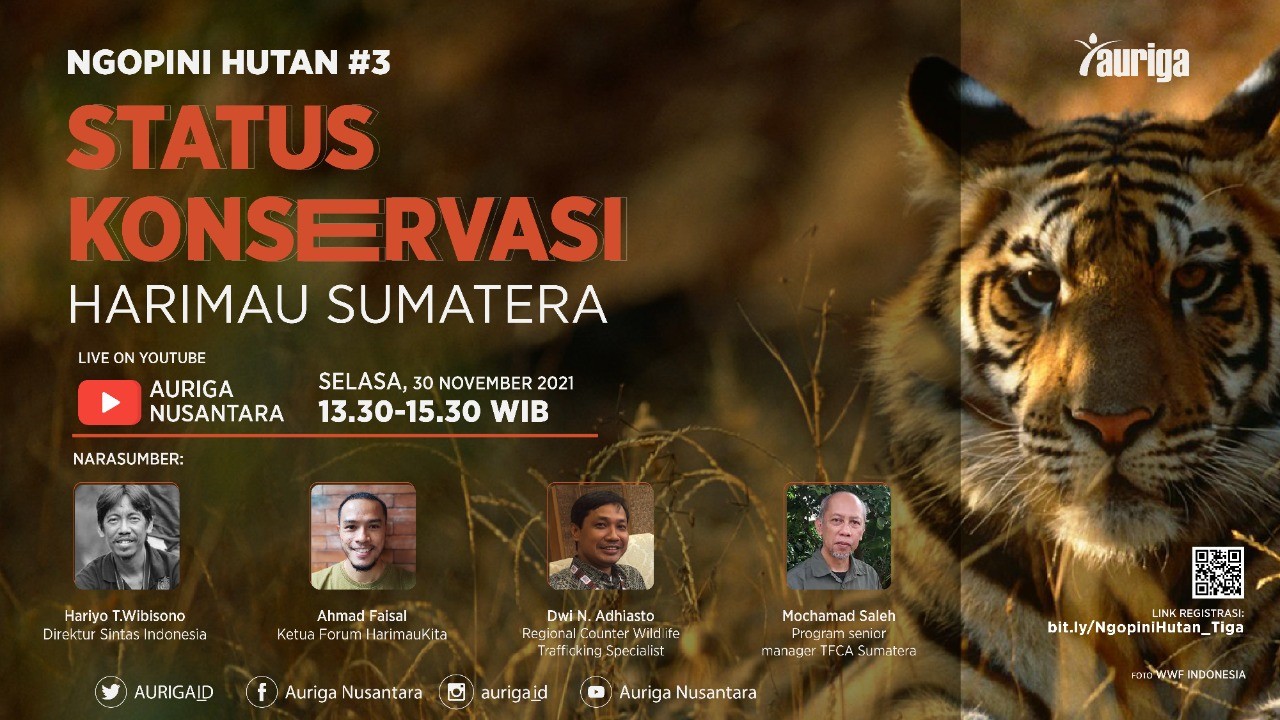
Main Topic:
- Approximately 70% of tiger landscapes are not protected.
- Tiger population has declined by more than 10% since 2008, local extinctions have occurred in at least 4 tiger landscapes since 2010.
- It is not only hunting and conflict with human, the Sumatran tiger is also facing the threat of disease, especially the deadly canine distemper virus (CDV) and African swine fever (ASF) which consumes the main tiger’s feed, namely wild board.
- Sumatran tiger hunting is relatively high while law enforcement performance tends to be low.
- Indonesia not only a hunting ground but also an end-market for the tiger trade.
- Conservation of species in Indonesia, including the Sumatran tiger, should be bases on science (scientific-based management).
Summary
In 2008, the Sumatran tiger (Panthera tigris sumatrae) populations of 439 individuals had decreased to 393 individuals in 393 individuals in 2017. This means that there was a decline of population for more than 10% during the time. Not only decline of population, the Sumatran tiger also experienced decrease number of landscape. In 2010, the Sumatran tiger was found in 27 landscapes, decreased to 23 landscapes in 2015, or local extinctions occurred in 4 landscapes in just 5 years. The fact was revealed by Hariyo T. Wibisono, commonly called Beebach, during the Tiger Conservation Status webinar held by Auriga Nusantara on November 30th, 2021.
“60-70% of Sumatran tiger (landscapes) are outside the protected areas,” concluded Beebach, who is also the Director of Sintas Indonesia.
Ahmad Faisal, Chairman of HarimauKita Forum, said that the threat to the Sumatran tiger also comes from diaseas, mainly because the government has not anticipated the threat of dieases to the exstience of this tiger seriously. Two diseases that have been confirmed to affect the Sumatran tiger are african swine fever (ASF) and canine distemper virus (CDV). CDV is a very deadly virus that infects tigers. ASF itself does not infect tigers, but is very deadly to wild boars. Due to the wild board is one of the main feed for the Sumatran tiger, the threat to the wild boar will ultimately threaten the survival of the Sumatran tiger.
Faisal added that the tiger hunting also a serious threat. It is proven that 3.285 snares were found in 6 Sumatran tiger landscapes in 2012 – 2019.
Dwi Adhiasto, founder of Science for Endangered and Trafficked Species (SCENTS), presents heart-wrenching data on the hunting of Sumatran tigers, but at the same time it is not balanced by adequate performance of law enforcement.
Compiling cases of illegal wildlife trade involving Sumatran tiger during 2010-2021, the evidence in all these cases represents at least 189 Sumatran tiger individuals. If we narrow it down in the last 5 years, 132 tigers was found in cases of illegal wildlife trade.
“Cases of tigers in Indonesia is not only the Sumatran tiger, there are also Bengal tiger, Siberian tiger, … lion … Indonesia indeed regarded as a part of network and international market as source site (tiger source) and also as a market,” added Dwi.
On the other hand, the punishment to convicts of traffickers and tiger reservoirs are very low, an average of 2.5 years, in contrast to the sentences for hunters which once reached 4 years. The low punishment at the level of traders and reservoirs have caused them not to be deterred from running their illegal business after leaving prison. In fact, these traders and reservoirs can buy tigers from various groups of hunters. The fine is relatively small, so far the maximum is Rp. 100 million. The problem is, it is possible to replace this fine (a subsidiary) with a prison term of 2 months. This means that law enforcement does not present a deterrent effect.
Faced with this kind of situations, all the resource person, as well as Moch. Saleh, Senior Program Manager for TFCA Sumatra, Sumatran tiger conservation requires an honest view of the situations on the ground and based on adequate scientific studies for the future. Considering the current government does not disclose adequate information to the public, nor has placed the answer to the mentioned problems as the main program for the tiger conservation. It can be seen, for example, the ratifications of the Sumatran Tiger Conservation Strategy and Action Plan has been suspended. In fact, it is needed not only for planning the government’s budget, also guiding the parties to carry out the activities in the field.
The entire event/webinar can be watched on Auriga Nusantra Youtube channel.
Resource Person
- Dr. Hariyo T. Wibisono (Director of SINTAS Indonesia): Sumatran Tiger: Past and Current Status
- drh. Ahmad Faisal (Chairman of the HarimauKita Forum): Sumatran Tiger Conservation Status
- Dwi Adhiasto (Founder of SCENTS): The Situation of Hunting and Trafficking of Sumatran Tigers in Indonesia.
- Moch. Saleh (TFCA Sumatra Senior Program Manager): TFCA Sumatra Support for Tiger Conservation and Other Species Flagship
Auriga also invited the Directorate General of KSDAE KLHK to be resource person who was unable to attend.
Belajar dari kebakaran hutan dan lahan 20 tahun terakhir
Conservation Performance of Sumatran Rhino