KEY POINTS
- If the Sumatran rhino becomes extinct, it will not only become a species extinction, but also and extinction of the genus/family.
- We agree that the Sumatran rhino is in a critical condition and there has been a lot of literature written about this.
- The Sumatran rhino population declines very quickly, even less than one generation.
- Public information must be good, factual, and not misleading so that we can make a good decisions.
- America has an endangered species act and also includes a critical habitat, while Indonesia has not reached that point. Ironically, in Indonesia even dirt and bones are protected, but not for their habitat.
SUMMARY
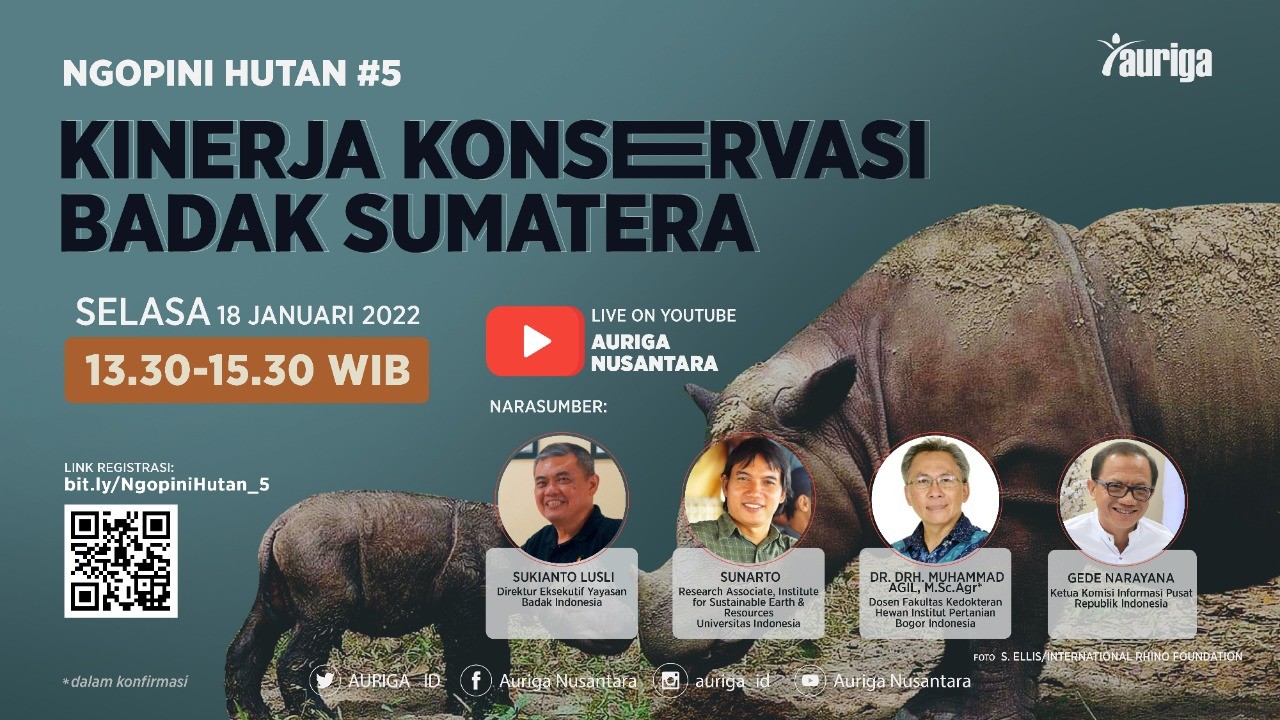
The Sumatran rhino has been under pressure from humans for a long time. The pressure caused by human acitivites is in the form of the threat of hunting, just to take the horns. Rhinos have a low reproductive capacity while hunting continues to cause population declines and local extinctions, such as in Kerinci Seblat National Park.
Sukianto Rusli, Director of Rhino Foundation of Indonesia (YABI) said that if the Sumatran rhino went extinct, it would not only occur in the species, but also in the genus/family. The condition of rhinos is increasingly worrying and has been proven by many literatures that have been written. Therefore, clear information is needed regarding Sumatran rhino because without sufficient and good information can cause difficulties in making decision and without sufficient information, it will be difficult to involve the participantion of the parties and will become unfavorable.
Sukianto Rusli also conveyed the thoughts of the Indonesian Rhino Foundation (YABI) as follows : First, for the Javan rhinoceros, it is necessary to provide the second habitat while for the Sumatran rhino, it is hoped that by 2025 there will be 10 sumtran rhino claves. So far, only two baby rhinos have been born. Second, how in the future these rhinos will be relocated to their new habitats and it definitely will be related to the carrying capacity of their new habitats. Third, regarding the threat to large mammals, this is due to the massive snares in their habitat so that the Rhino Protection Unit (RPU) is still very much needed. Based on that, better attention is needed from the government regarding conservation financial.
Sunatro, as Research Associate Institute for Sustainable Earth & Resources – University of Indonesia explained that the most common question is how many rhinos there are and this is a simple question yet difficult to answer. Specifically animals that are already very rare such as the Sumatran rhinos. Finally we agreed not to ask again how much of it. It was already very rare obviously and way too rare to even count. The population is still in nature but no one knows the exact conditions.
The challenges in saving the Sumatran rhino at this time are the Ecological Allee Effect, Social Allee Effect, and Political Allee Effect. Decision making becomes so complex because there are so many people who care and that can actually be and obstacle, so the Social Allee Effect becomes a new challenge. While the Political Allee Effect is influential because of the slow decisions making, because in a decision there are risks that must be borne.
The solution offered is the implementation of urgent action in adaptive and synergistic manner by the mandate holder and also key partners. Public understanding regarding the need for action including the risks that need to be taken to save and support resources, policies and morals for action makes and implemeters in the field.
Gede Narayana, chairman of the central information commission, conveyed that information related to rhino conservation, such as how the condition of rhino conservation and the number of rhino populations is, is a right for all citizens and protected by law on the right to receive information. In addition, public information should be good, factual, and not misleading so that we can make a good decisions.
Gede Naraya also added that the domain of the Public Information Commission’s authority is to settle dispute trials, and that dispute resolution is not between public agencies but between the applicant and the respondent. The applicant is every citizen, legal entity organization and group of people. The respondent is a public body. Based on these things, let’s make public information disclosure properly, correctly and according to the rules to all parties.
The entire event/webinar can be watched on Auriga Nusantara Youtube Channel.
Resource Person:
- Sukianto Rusli (Director of Rhino Foundation of Indonesia): Sumatran Rhino Conservation Status
- Sunarto (Research Associate, Institute for Sustainable Earth & Resources - University of Indonesia): Critical to Save the Sumatran Rhino.
- Gede Narayana (chairman of The Central Information Commission): Classification of Private and Public Information on Species Conservation.
Belajar dari kebakaran hutan dan lahan 20 tahun terakhir
Neglected Spesies #1: Javan Leopard Conservation Status