KEY POINTS
- The government has stated that it will not issue any new licenses for extractive activities in the new State Capital City (Ibu Kota Negara or IKN), and will not extend any extractive licenses that currently remain valid.
- Spatial and population data for IKN from the regional and central government remains asynchronous.
- The smart forest city concept proposed for IKN could become a model and the new face of urban development in Indonesia. If remaining natural forest inside the site is protected, and if existing plantation forest is not cut down and oil palms are gradually converted to a variety of woody vegetation, and mining pits are rehabilitated, then IKN actually has the potential to add to Indonesia’s forest cover.
- KN being a forest city is not an impossibility as long as the government remains true to and consistent with the smart forest city concept, and enforces the law in the event of any violations of IKN spatial planning.
SUMMARY
As explained in Article 2 of the Elucidation of Law No. 3/2022 on the State Capital City (IKN), Indonesia’s new capital will be built as a forest city. One way of doing so is to ensure there are no extractive licences inside IKN.
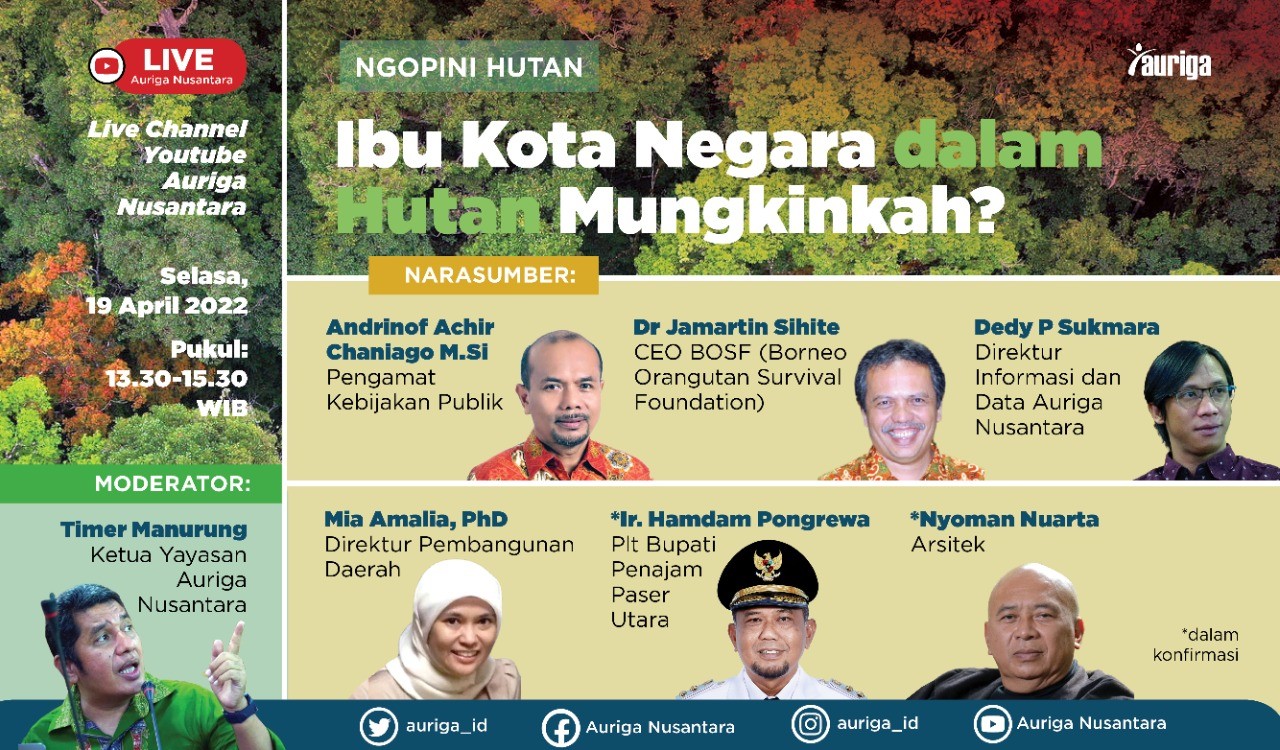
“New licenses will not be established (issued), those (licenses) that have finished will be stop immediately. Licenses with time remaining will continue to run, but with sustainable mining principles,” explained Bappenas Deputy for Maritime Affairs and Natural Resources, Arifin Rudiyanto during the webinar A Forest City as the State Capital: Is it Possible? Held by Auriga Nusantara on 19 April 2022.
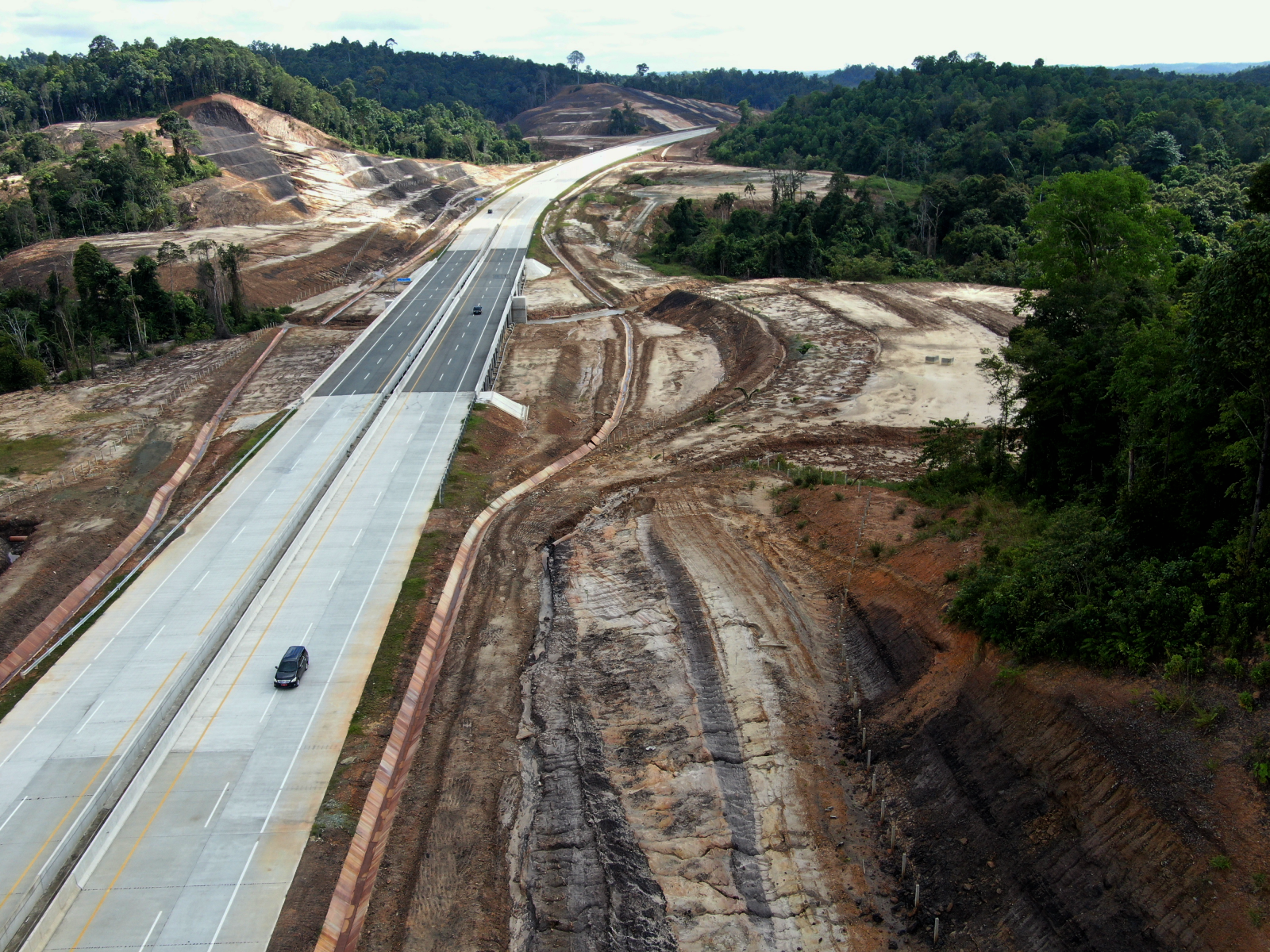
A toll road bisecting forest constructed in IKN. The government needs to calculate total deforestation that will occur from the development of infrastructure and buildings, and ensure forest cover is replaced so there is no net-deforestation from IKN. @Dandy Koswaraputra.
Andrinof Chaniago, a public policy observer and former Minister of National Development Planning (Bappenas) when the proposal to move the national capital city was initiated in 2015, warned that the next issue is to ensure the IKN concept and design is implemented according to the existing plan. “The next issue is to ensure its execution and realization,” he added.
This signal relayed by Andrinof is nothing new, and is apparent at the very least from various distortions in the implementation of development programmes to date. In addition, as Andrinof confirmed, with IKN there are already indications of land mafias and speculators emerging, which are likely to trigger property development beyond the designs made to date.
For Jamartin Sihite, Chief Executive Officer of the Borneo Orangutan Survival Foundation (CEO BOSF), building the new capital with a forest city concept is not an impossibility. Jamartin was not overstating this, as he based his statement on BOSF’s experiences managing around 2,000 hectares of land inside the area designated as the new capital city. Two decades ago, BOSF bought the APL other land use area (APL, meaning non-forest estate land) when it was in a critical state completely devoid of forest cover. With the consistency of BOSF’s reforestation programme, the area is now forested.
Further, Jamartin proposed that corridors between natural ecosystems be established in IKN so that in addition to its forest cover being maintained, the region’s existing biodiversity will not become fragmented.
Nevertheless, Nicko Herlambang, Head of the North Penajam Paser District Government Development Division, reminded everyone that IKN development should not forget the local population, so the central government must involve North Penajam Paser District Government in spatial planning for IKN and its surrounding area. At the moment, Nicko relayed as an example, central and regional government data in IKN is asynchronous, both in terms of spatial boundaries and population.
“We mustn’t forget that people have been living in the IKN region for many years,” said Nicko.

Part of the area designated as IKN in North Penajam Paser. Eucalyptus plantation forest monoculture is the dominant land cover. @Dandy Koswaraputra
Auriga Nusantara identified land cover in the IKN area comprising 32,481 hectares of natural forest cover, 57,388 hectares of plantation forest, 16,061 hectares of oil palm plantations, and 10,680 hectares of mining pits. So, for IKN to be built as a forest city, Auriga recommended spatial planning for IKN: (1) not issuing new extraction licenses, including not expanding existing extraction; (2) protecting remaining natural forest; (3) not cutting down existing plantation forest; (4) converting oil palm cover to multi-crop woody vegetation in stages in line with the Jangka Benah concept; and (5) ensuring the rehabilitation of existing mining pits.
“If all of this is done, the development of IKN could create an additional 100,000 hectares of forest cover,” added Dedy Sukmara, Director of Information and Data with Auriga Nusantara.
Therefore, incentives should be provided for local people to maintain forest cover in the IKN area. Furthermore, Dedy viewed that IKN (development) could become the new face of Indonesia’s success in overcoming the issue of overlapping licenses and land uses.
The whole event is available to view through the Auriga Nusantara YouTube channel.
SPEAKERS AND PRESENTATIONS
- Arifin Rudiyanto (Deputy for Maritime Affairs and Natural Resources - Bappenas) – The Plan to Move the State Capital City
- Nicko Herlambang (Head of the North Penajam Paser District Government Development Division) – Development Direction in North Penajam Paser District and its Links to the State Capital City in North Penajam Paser District
- Andrinof Chaniago (public policy observer) - 15 Reasons to Move the State Capital City to Kalimantan and a Strategic Framework for Execution
- Jamartin Sihite (CEO BOSF - Borneo Orangutan Survival Foundation) – Becoming Part of the State Capital City
- Dedy P Sukmara (Director of Information and Data - Auriga Nusantara) - IKN’s Potential to Add to Indonesia’s Forest Cover
Belajar dari kebakaran hutan dan lahan 20 tahun terakhir
Conservation Performance of Sumatran Rhino