- Our new investigation reveals wood used in America’s favourite recreational vehicles (RVs) can be traced to the devastation of Borneo’s rainforests
- The RV industry is the largest consumer of tropical wood in the United States, using an average of 500 giant trees every day
- Just three corporations make 86 per cent of the RVs sold in America. Earthsight and Auriga found plywood from deforestation in Indonesia in the supply chains of all three
- This includes the US’s best-selling RV brand, Jayco, whose wood supplies are linked to a project clearing three football pitches of orangutan habitat every day
- These findings seriously contradict RV companies’ declared commitments to nature and sustainability
- RV makers must ban the use of timber from deforestation, and put in place robust traceability systems to ensure all wood is sustainably sourced
As featured in The New York Times
Recreational vehicles, or RVs, are big business in the United States. Over 11 million households own one – more than ever before.[1] Yet despite the industry promoting a back-to-nature, sustainable lifestyle, new research from Earthsight and our Indonesian partner Auriga Nusantara reveals that some of America’s favourite RVs are built from the destruction of pristine rainforests on the other side of the world.
Thin sheets of lightweight, water-resistant ‘lauan’ plywood – a tropical hardwood also known as meranti – are used to make RV walls, floors and ceilings.[2] As much as 700 square feet may be used in a typical RV.[3]
Earthsight and Auriga began investigating this over a year ago, when research into wood produced by one of the top deforesters in Indonesia, PT Mayawana Persada in West Kalimantan, Borneo, led us to a California plywood importer. One of that company’s main markets for lauan, we found, is the RV industry.
Digging deeper, it became clear that this one supply chain was just the tip of the iceberg. We discovered that the booming RV industry, unwittingly supported by nature-loving Americans, has turned the US into the world’s largest consumer of Indonesian tropical wood.
We found that the US companies importing and using lauan from deforestation are well aware of the environmental impacts, while publicly claiming that sustainability is at the core of their business. Yet they refuse to pay the tiny extra cost of more sustainable wood. The result? Their supply chains are awash with timber from devastating deforestation, and American RV users are being unwittingly made complicit in industrial-scale environmental destruction.
BORNEO BULLDOZED
Indonesia lost 10.7 million hectares (ha) of tropical primary forest between 2002 and 2024 – an area larger than Kentucky that was once home to orangutans, rhinos, elephants and tigers.[4] Only Brazil has lost more. Most of this was cleared to make way for oil palm, or for plantations of fast-growing timber used by the wood and paper industries.
Despite a decline in the late 2010s, deforestation in Indonesia is rising again. Analysis by Auriga found that in 2024, Borneo lost the most forest of all Indonesia’s islands. Within Indonesian Borneo, the province with the greatest loss was East Kalimantan, above all in a district called East Kutai.[5] Scouring satellite imagery and government maps for the district, we were able to identify the prime culprit.
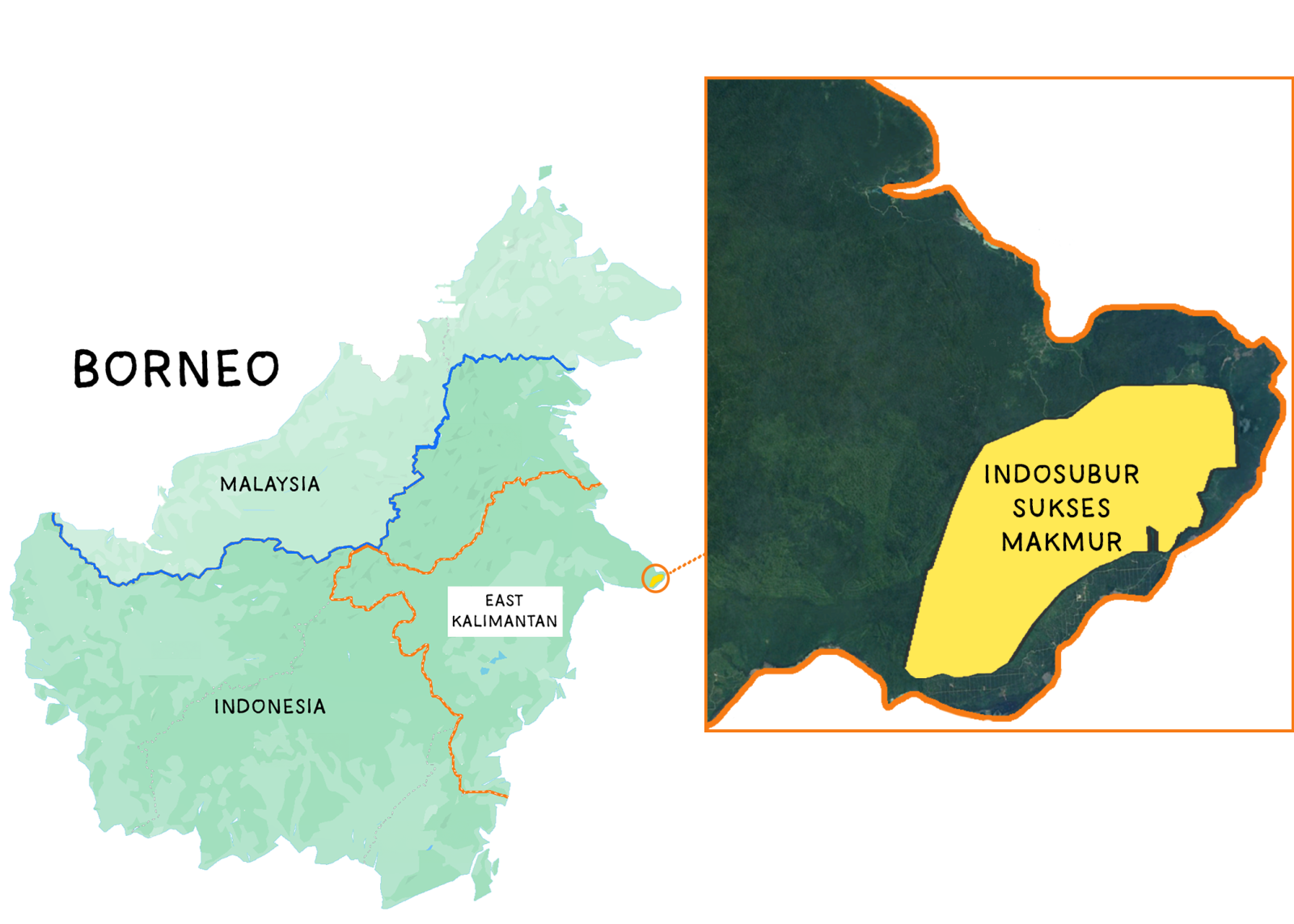
The Indonesian company PT Indosubur Sukses Makmur holds a license to convert more than 28,000ha of orangutan habitat in East Kutai – an area almost five times the size of Manhattan – into timber plantations. Since 2021, it has bulldozed more than 1200ha of tropical rainforest – more than three times the size of New York’s Central Park – to replace it with an ecological desert of non-native species like acacia and eucalyptus, used to produce wood products, and wood pellets to be burned for energy production. In 2024 alone, it cleared 432ha, and there has been no sign of a let-up since. A comparison of satellite images from 7 January and 2 March 2025 shows that PT Indosubur Sukses Makmur was clearing an average of three American football pitches’ worth of forest every day through this period.[6]
A SCENE OF DEVASTATION
Satellite images couldn’t prepare us for what we found when we visited the concession in January 2025. Stunning swathes of dense tropical forest, stretching as far as the jagged karst hills on the horizon, suddenly made way for apocalyptic expanses of bare earth, crossed by fresh dirt roads and heavy machinery at work transporting freshly-cut logs.
Meetings with local communities revealed the human cost of the destruction. The Indigenous Dayak community of Teluk Sumbang village, whose boundaries overlap with the concession, have seen their traditional way of life threatened since PT Indosubur Sukses Makmur’s operations began. Local residents told our investigators that the company’s activities have disrupted their access to natural rattan and honey, which they rely on for their livelihoods, and that compensation and communication with the company has been minimal.

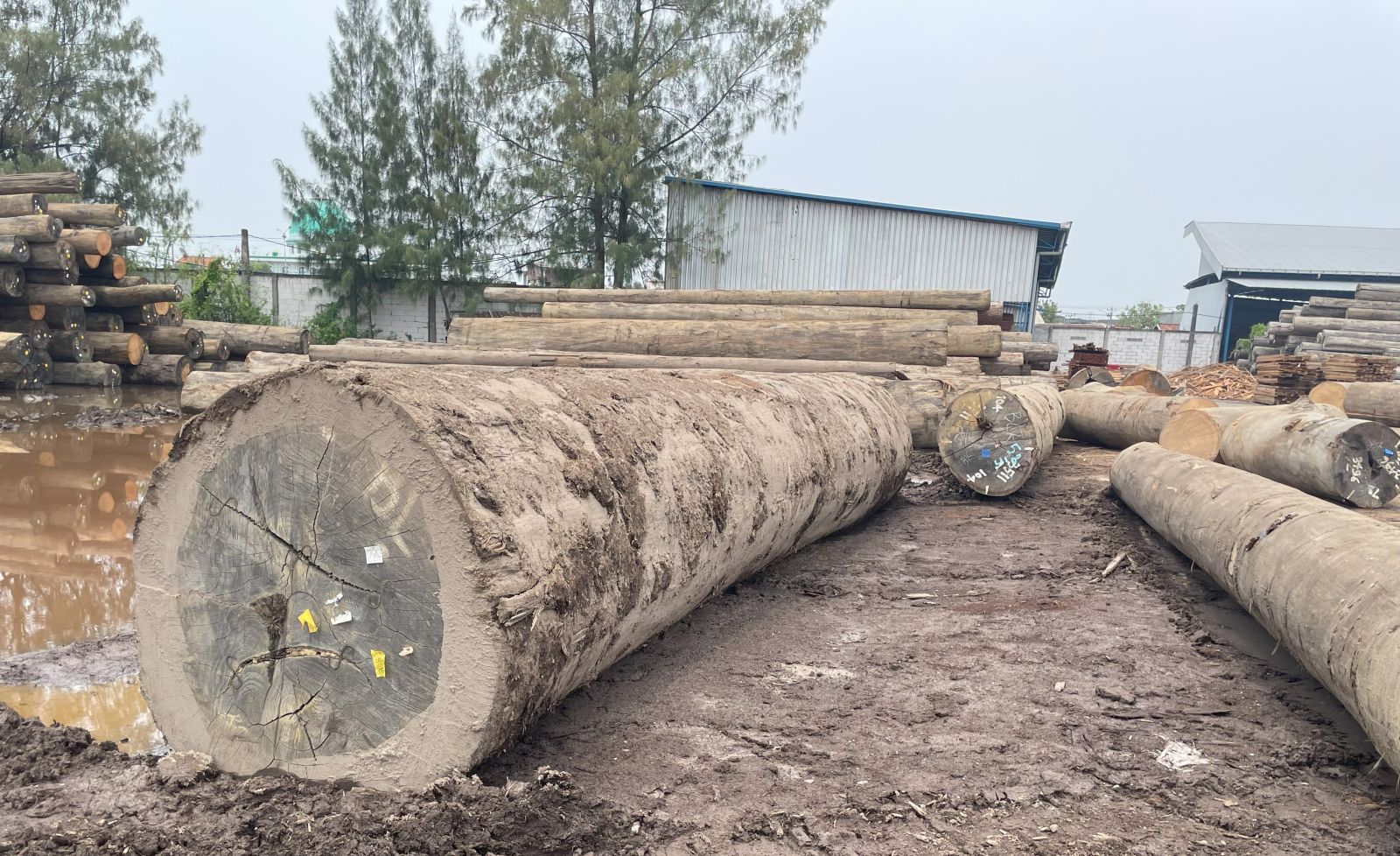
Clearing forest costs money, and PT Indosubur Sukses Makmur’s bulldozers are kept fuelled by the sale of the trees they fell. In Indonesia, logs produced during the clearance of forest for agriculture and mining are a major source of raw material for the timber industry. This deforestation wood is cheaper than timber produced through ‘selective’ logging, where a limited number of trees are felled and the forest then left to recover.
We use the term ‘deforestation wood’ to refer to natural forest timber that is produced when forests are cleared, as opposed to selective logging. This is also known as ‘conversion wood’ or ‘conversion timber’, referring to the process of forest being ‘converted’ into a plantation. When the companies involved have the necessary permits to clear forest and sell the resulting timber, this deforestation wood is legal.
Of the trees that are felled and processed, the most important is meranti (genus Shorea), the principal tropical timber species used in plywood production. The manufacture of plywood is by far the biggest consumer of tropical logs in Indonesia. In the United States, meranti is usually known as lauan.

RAINFOREST-DESTROYING RECREATION
By analysing international shipment records, company statements and timber procurement documents, we were able to trace deforestation wood from PT Indosubur Sukses Makmur to major US timber companies that supply the US RV industry with lauan plywood. Our findings expose an industry that is anything but sustainable.
According to the RV Industry Association, lauan plywood is used in the manufacture of almost every RV.[7] The most popular type of RV in the United States is the travel trailer, 40 per cent of which are made by just one company, Thor Industries. The stock exchange-listed company is the world’s largest RV maker and owns a suite of RV brands, including Jayco and Airstream.[8]> Jayco’s website confirms that its RVs, including America’s best-selling RV model, the Jayco Jay Flight, are constructed using lauan plywood.[9]
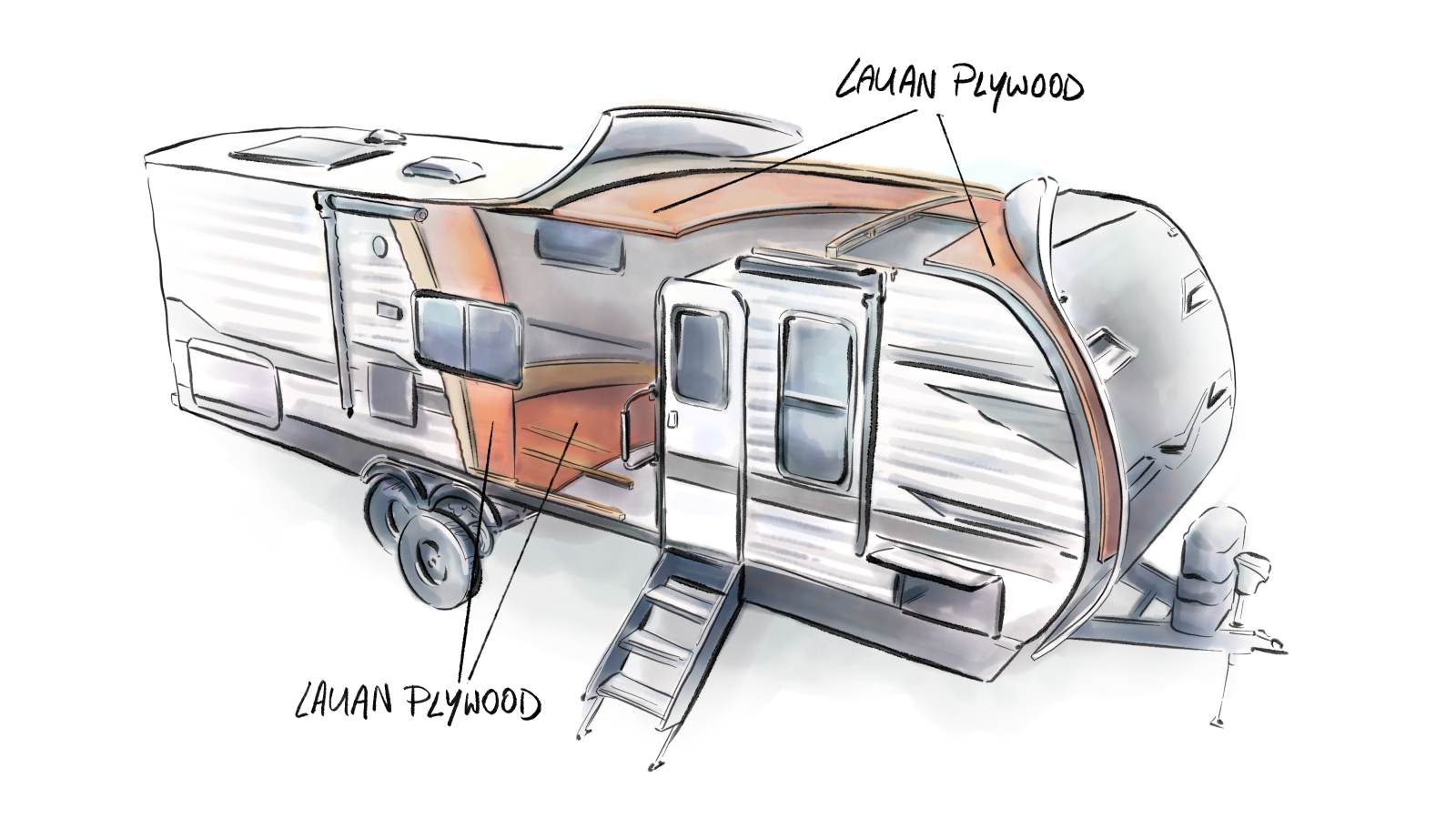
Jayco’s largest supplier of lauan plywood, as revealed by the company’s 2023 supplier awards, is a company called MJB Wood.[10] Shipment records seen by Earthsight/Auriga reveal that one of MJB’s suppliers of meranti/lauan plywood is the Indonesian company PT Kayu Lapis Asli Murni (PT KLAM). The most recent shipment from PT KLAM to MJB Wood, of seven container-loads, landed in Baltimore on 3 April 2025. PT KLAM’s official wood sourcing records submitted to the Indonesian government show that 87 per cent of the tropical wood used by the company in 2024 came from just one source – forest clearance in the concession of PT Indosubur Sukses Makmur.
A wider analysis of timber sourcing records for all large mills in the country reveals PT KLAM was the second-largest buyer of deforestation timber in Indonesia in 2024. Meanwhile, shipment records show that 50 per cent of the company’s exports in 2024 were to the United States. PT KLAM is part of the Salim Group, Indonesia’s biggest conglomerate. The group's billionaire head Anthoni Salim remains the CEO of PT KLAM.[11] Salim's companies are among Indonesia’s most notorious forest destroyers of recent years.[12]
Shipment records show that MJB Wood also sourced lauan plywood from two other Indonesian companies in the first three months of 2025. Timber sourcing records and audit reports produced through Indonesia’s timber licensing and certification system reveal that both of these companies have also been buying wood derived from deforestation in Borneo, increasing the risk that MJB Wood’s imports contain deforestation wood.

MJB Wood claims to be “dedicated to responsible sourcing and manufacturing.”[13] Thor Industries, meanwhile, claims that “sustainability is a core principle upon which we operate our company,” though its 50-page 2024 sustainability report makes no mention of its use of wood from precious tropical forests.[14]
PT Kayu Lapis Asli Murni’s biggest US customer, meanwhile, is Tumac Lumber.[15] Tumac Lumber currently lists “RV Manufacturers” as among its three “client types” for meranti plywood sourced from Indonesia.[16] Both Tumac Lumber and MJB Wood have supplied raw materials to Patrick Industries, a stock exchange-listed company and key parts supplier to RV makers in the US.[17] This exposes Patrick Industries to the risk of meranti/lauan plywood sourced from deforestation entering their supply chain.
MJB Wood has doubled down on lauan plywood, building a vast 500,000- square- foot warehouse in Elkhart County, Indiana, from which to distribute it to RV makers.[18] Elkhart County is known as the RV capital of the world, and hosts the headquarters of Patrick Industries, Thor Industries and rival RV giant, Forest River.
Thor and Forest River are Patrick Industries' largest customers, together buying over $1 billion of parts and raw materials from Patrick in 2024.[19] Patrick Industries also supplies Winnebago Industries.[20] Patrick Industries’ environmental responsibility policy is just one page long, pledging it will “work with vendors to strengthen the social and environmental aspects of products and services we deliver to our customers.”[21] Not a single mention of wood is found in its 2024 sustainability report.[22]
It is impossible to say with certainty that a particular vehicle or production line is using deforestation wood from Indonesia. But these figures – and the apparent lack of any efforts to avoid such sources – mean it is almost certain that the Indonesian lauan/meranti plywood imported by MJB Wood and Tumac Lumber from PT KLAM and other Indonesian suppliers and sold on to customers in the RV industry includes wood from deforestation in Borneo.
All companies named in this report were repeatedly approached for comment; no responses had been received by the time of publication.
AN INDUSTRY-WIDE PROBLEM
Our analysis has revealed that the RV industry is now by far the largest consumer of tropical wood in the US, replacing housebuilders, who have increasingly moved on to cheaper alternatives.[23] An industry source estimates that at least a third of all tropical plywood imported into the country is now destined for RV production, while customs data suggests the proportion is closer to half. Imports of lauan plywood in 2024 were up 88 per cent compared to the year before.[24]
Largely as a result of RV-related demand, in 2024 the United States overtook Japan to become the world’s largest importer of Indonesian plywood.[25] Our calculations show that every day, around 500 meranti trees are chopped down in Indonesia to supply RV construction in America.[26]
These trees are among the most controversial being harvested in Indonesia. Looking at the industry as a whole, we found that almost half of US lauan plywood imports in 2024 came from companies buying deforestation timber directly, while another 19 per cent came from those buying logs from middlemen who, in turn, bought deforestation wood.[27]
“ALL THEY CARE ABOUT IS PRICE”
This is not due to a lack of more sustainable options. Meranti logs from forests certified as being sustainably managed by the Forest Stewardship Council (FSC), the world’s largest green label for wood, are plentiful in Indonesia.[28] Yet almost none are being used by the American RV industry because it is unwilling to pay the additional premium. PT Kayu Lapis Asli Murni, supplier to MJB Wood and Tumac Lumber, bought no certified logs at all in 2024.
Nor can this be attributed to ignorance. The environmental cost of using lauan is no secret in the RV industry. Thor Industries’ CEO admitted in 2021: “[...] for decades, the RV industry has sourced lauan wood from tropical hardwood forests which continue to be over-harvested.”[29]
The truth is much simpler. “The RV companies never ask about sustainability,” a plywood industry insider told us. “All they care about is price.”
This is doubly shocking given the extremely small price they would actually need to pay to meet the most basic standard of sustainability. If – like US home improvement giant Home Depot[30] – the RV makers demanded all their lauan be FSC-certified, we estimate the average cost of an RV would rise by at most $20, or 0.06 per cent.[31] It need not go up at all if the manufacturers absorbed the extra fee – peanuts compared to their annual profits. At the height of the recent RV boom, Thor posted $2.2 billion in annual profits from sales of RVs in the US.[32]
RV INDUSTRY MUST ACT NOW
In Europe, a law will take effect in December 2025 which bans the import of products linked to deforestation, including wood. The European Union Deforestation Regulation (EUDR) requires importers to trace their supplies of timber and other commodities that drive deforestation – such as beef, palm oil and soy – back to the plot of land where they were harvested, to ensure they were produced legally, and not on land deforested since 2020.
While Indonesian exporters of lauan plywood to the EU are cleaning up their supply chains, there is no such pressure on exporters to do the same for the much larger volumes sent to the US.
An existing US law, the Lacey Act, does ban US companies from importing wood that was illegally harvested or traded. But it does not ban wood from legal deforestation – like the timber from PT Indosubur Sukses Makmur, which holds a permit to clear forest. Nor does it require US importers to obtain details about the wood’s origin beyond the species and country of harvest. US environmental groups have also denounced a failure to fully enforce the law. [33]
To stop RV buyers and other consumers being complicit in the destruction of Indonesia’s forests, the US government should pass legislation like the EUDR, prohibiting US companies from buying deforestation wood. At a minimum, it should strengthen Lacey Act enforcement by adding a traceability requirement.
Yet with the likelihood of this slim under the present administration, it is up to RV makers to act. The three implicated in our investigation – Thor Industries, Forest River and Winnebago – made more than 86 per cent of the towable RVs and 83 per cent of motorised RVs sold in America last year.[34] They have the power to transform the RV business into the environmentally-responsible industry it presents itself as.
A love of nature and the great outdoors is the number one reason Americans give for buying RVs.[35] It is perhaps unsurprising then, that studies show they are “willing to pay a higher price for eco-friendly RVs.”[36] Surely they will be aghast to learn the true cost of their hobby for the world’s precious rainforests. These unhappy campers must demand action.
RECOMMENDATIONS
Rv makers and their supliers
- Thor Industries, Forest River and Winnebago, and their suppliers including MJB Wood and Patrick Industries, must take urgent action to remove deforestation wood from their supply chains
- The companies must commission an independent expert assessment of their wood supplies, tracing them back to where the wood was grown, and publish the results
- They must produce detailed wood buying policies of the kind already implemented by other US corporates facing similar risks. Those policies should:
- Prohibit the purchasing of products made by mills using deforestation timber
- Require wood to be independently certified as legal, sustainable and deforestation-free by FSC under its new, stricter EUDR-compliance standard
- Address continued weaknesses in FSC by also demanding full traceability, checked by audits and scientific testing
- Require annual publication of progress against the policy
RV buyers, owners, and retailers
RV buyers, owners and retailers must demand that RV makers take the urgent actions listed above. Until this happens, they should refuse to buy RVs made with lauan plywood. They should raise this issue with their local RV dealers, who must also add their weight to calls for action by the manufacturers.
Shareholders of RV makers and supliers
- Thor Industries (THO), Winnebago (WGO) and Forest River (via Berkshire Hathaway, BRK) are all listed on the New York Stock Exchange, while supplier Patrick Industries (PATK) is listed on NASDAQ
- Shareholders of these businesses must demand action to address the issues raised in this report, which threaten to damage their brand, sales and profits, and are contrary to the sustainability promises made to investors
Notes: All links working as of 4th June 2025 - Earthsight has pdf backup of most pages -
contact info@auriga.or.id or info@earthsight.org.uk.
Artikel Lainnya
Entering the Elephant House

Javan rhino : conservation setbacks in ujung kulon national park (2023)
Jakarta, 11 April 2023 - Eighteen Javan rhinos (Rhinoceros sondaicus sondaicus) have disappeared in Ujung Kulon since 20...
New Analysis: Batang Toru Hydroelectric Plant Unnecessary
JAKARTA, 22 JANUARY 2020 — The Batang Toru Hydroelectric Power Plant (PLTA) built with a budget of USD 1.6 billion (equi...