Updated 22 July 2020--The Indonesian government appears to be planning planned deforestation in the name of peat protection. This can be seen after the Anti-Forest Mafia Coalition analyzed the spatial allocation of land swaps published by the Ministry of Environment and Forestry (KLHK).
The land swap policy is the government's response to plantation forest concessions (HTI) which are affected by the peat protection policy to prevent forest and land fires from recurring. As regulated by Peraturan Menteri Lingkungan Hidup Dan Kehutanan No. P.40/2017 concerning Government Facilitation in Industrial Plantation Forest Business in the Framework of Protection and Management of Peat Ecosystems, land swap is granted to HTI license holders whose working area is 40% or more designated as a peat ecosystem with a protection function. Of the total 12.94 million ha of priority area for peat restoration carried out by the Peat Restoration Agency (BRG), 2.15 million ha of which or the equivalent of 16% are in HTI concessions, of which 216,044 ha experienced extraordinary fires in 2015.
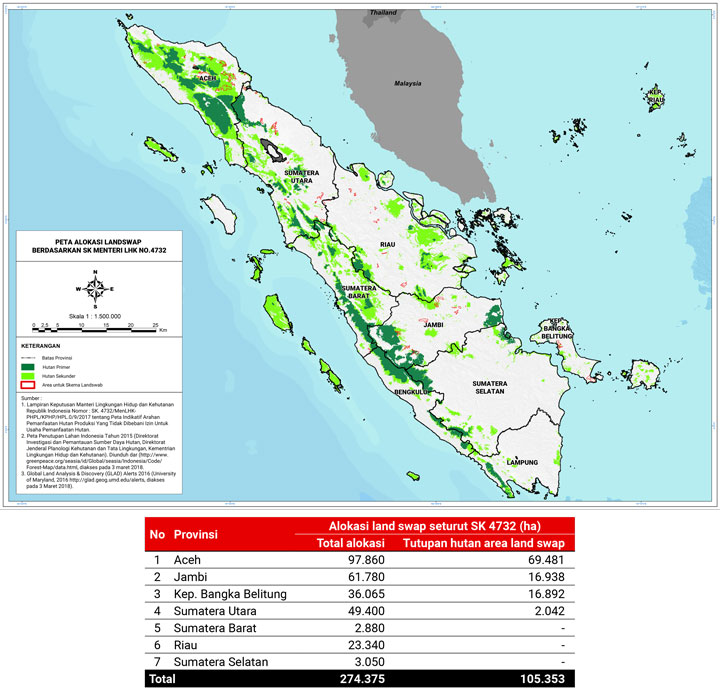
Through its website, the Ministry of Environment and Forestry publishes Decree of the Minister of Environment and Forestry No. SK.4732 / MenLHK-PHPL / KPHP / HPL.0 / 9/2017 concerning the Indicative Map of Directions for Utilization of Production Forests that are Not Burdened with Permits for Forest Utilization Businesses (hereinafter referred to as SK 4732). The land swap allocation map is listed in the Attachment to the SK 4732 Direction Map.
Even though the map was small in scale (1: 500,000), or did not meet the Geospatial Information Agency's requirements regarding operational maps, the Anti-Forest Mafia Coalition attempted to analyze it spatially and found that of the total allocation of 921,230 ha for land swaps, 362,390 ha or 40% of them were forest cover, both primary and secondary forest.
An area of 70% (251,137 ha) of natural forest that is affected by land swaps, in broad order, is located in Aceh, Papua, Central Kalimantan, East Nusa Tenggara, and Maluku. Of the total 19 provinces allocated for land swap, only 5 provinces (West Sumatra, Riau, South Sumatra, West Nusa Tenggara and Central Sulawesi) are not in natural forest. However, the land swap allocation area in these 5 provinces is relatively small, namely 36,070 ha or only 3% of the total allocation.
On the island of Sumatra, land swaps have been allocated for an area of 274,375 ha spread across 7 provinces. An area of 105,353 ha of which is natural forest located in Aceh, Jambi, Bangka Belitung and North Sumatra.
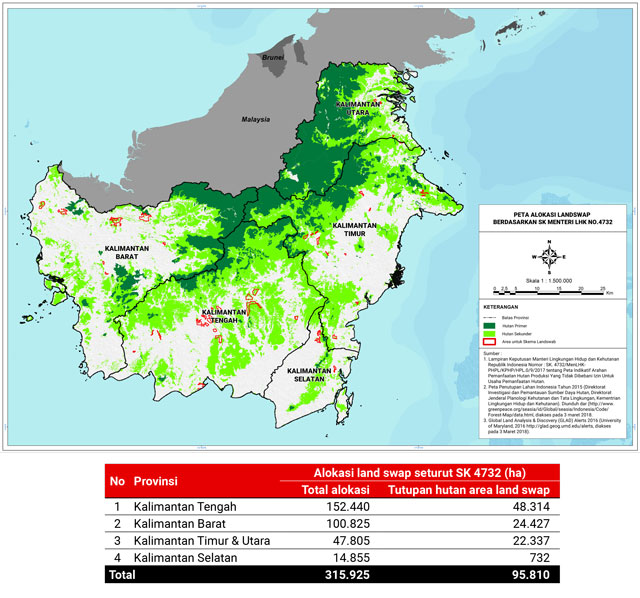
The largest allocation of land swaps in natural forests occurred on the island of Kalimantan, covering an area of 95,810 ha (or 26% of the total natural forest affected by the land swap). This natural forest is scattered in Central Kalimantan, West Kalimantan, East & North Kalimantan, South Kalimantan.
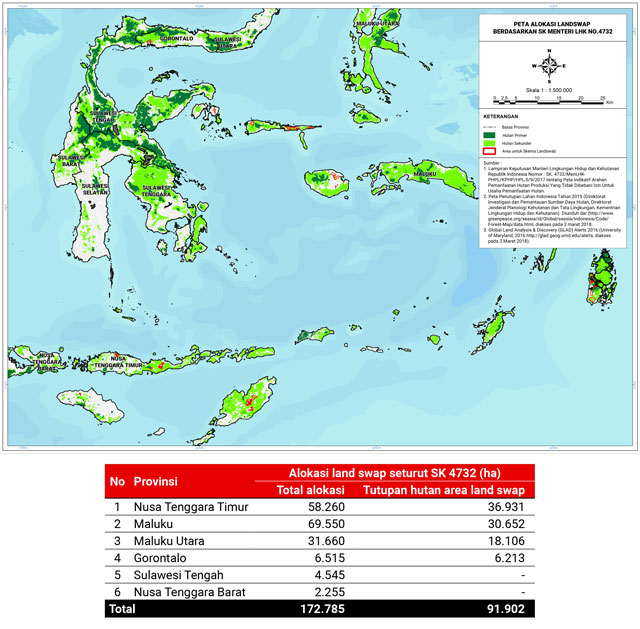
Serious threats to natural forest cover by land swaps also occurred in East Nusa Tenggara, Maluku and North Maluku. In fact, the natural forest landscape in the archipelago is much smaller than the other large islands in Indonesia. An area of 85,689 ha of natural forest in these three provinces has been allocated for land swaps. It is very possible that this has been triggered by the categorization of forest functions that have relied more on the slope of the slope, the type of soil and the intensity of rain as regulated by Government Regulation 26/2008 concerning National Spatial Planning which was later changed to Peraturan Pemerintah No. 13/2007.
As it is of concern, the government still sees Papua Land as an area of exploitation, as seen from the allocation of 65,759 ha of natural forest for land swaps in Papua Province. This allocation is mainly in the southern part which is relatively flat and has low rainfall intensity. In West Papua Province 3,566 ha of natural forest have also been allocated for land swaps.
The allocation of natural forest for the land swap actually shows the inconsistency of the Ministry of Environment and Forestry, because previously through a press release, the Secretary General of the Ministry of Environment and Forestry, Bambang Hendroyono, had said that the land swap allocation would be directed at unproductive concession areas and potential HTI areas. Based on data from the Ministry of Environment and Forestry's Directorate General of Sustainable Production Forest Management, the Anti-Forest Mafia Coalition suspects that there are at least 1,153,949 ha of HTI currently that should be revoked, so even if the land swap policy is implemented, it should be directed to these areas.
On the other hand, the existing land swap policy does not stipulate a detailed and strong and legally binding mechanism to ensure that companies that develop plantation forests on peatlands bear the burden of restoration. Therefore, the allocation of replacement land without a clear arrangement raises its own concerns. From the cost side alone, peat restoration requires a lot of money, depending on many factors, such as location, drainage structure, and the current condition of the peat, which reaches tens of millions of rupiah per hectare. In fact, of the 2.1 million ha of priority restoration in HTI concessions, there are 1.4 million ha of plantation forest that need to be restored.
The land swap should be allocated after the company has first restored the peat it has drained. The recovery is complete, or at least verified that it is being carried out by the company, then the Ministry of Environment and Forestry will provide replacement land. Without such provisions, companies will easily avoid the burden of recovery from the damage or disaster they have caused. Therefore, the Government should first conduct an in-depth study of the proposed land swap allocation, and the process should be carried out in a transparent manner, so as to minimize pressure on natural forests and avoid escalating conflicts between HTI license holders and local communities or customary communities who may have already inhabited or manage the area.
Based on the aforementioned matters, the Anti-Forest Mafia Coalition proposes that the land swap area is only the area of the company's current plantations (existing plantation only), not based on the area of the concession license, and follows the following criteria:
- Prioritizing HTI areas on mineral soils that have not been operated (sleeping permit);
- Not a natural forest, either primary forest or secondary forest;
- Not a customary / local community management area.
The Anti-Forest Mafia Coalition also recommends that the Indonesian government:
- Publish the revised RKU and RKT results of HTI companies affected by peatland restoration obligations, especially those whose land was burned during 2015-2018. And also the names of companies that have submitted RKU and RKT revisions and are unwilling to revise the RKU and RKT;
- Publish peat ecosystem restoration plans that have been submitted by companies holding IUPHHK permits and have been approved by the Ministry of Environment and Forestry;
- Identifying areas according to the 3 criteria above to be selected as potential land swap areas, and only designating problem-free and conflict-free (clear and clean) areas from the list of potential which are designated as land swap areas;
- The licensing of the land swap area is carried out openly and involves public participation;
- Improve the land swap policy by ensuring that the land swap is only located according to the 3 criteria above and ensuring that companies that have acquired new areas remain responsible for restoring the peat areas that they left behind.
MORE REPORT
Contact:
Syahrul Fitra (Auriga) syahrul@auriga.or.id
Wirya (Jerat Papua) snonkaku@yahoo.com
Dimas Novian (Walhi Kalteng) dimaznovian@gmail.com
Made Ali (Jikalahari) madeali.26@gmail.com
Aidil Fitri (HaKI) aidilplg@gmail.com
———–o0o———–
Note:
Updated from previous release: (1 Maret 2020) Perlindungan Gambut Bukan Alasan Untuk Menghabiskan Hutan Alam Tersisa: Kebijakan Land swap Berpotensi Deforestasi Dari Aceh Hingga Papua
Artikel Lainnya
Entering the Elephant House

Javan rhino : conservation setbacks in ujung kulon national park (2023)
Jakarta, 11 April 2023 - Eighteen Javan rhinos (Rhinoceros sondaicus sondaicus) have disappeared in Ujung Kulon since 20...
New Analysis: Batang Toru Hydroelectric Plant Unnecessary
JAKARTA, 22 JANUARY 2020 — The Batang Toru Hydroelectric Power Plant (PLTA) built with a budget of USD 1.6 billion (equi...